

What is syringomyelia?
Say it: sir-RING-o-my-elia
Syringomyelia is a rare neurological condition in which a fluid-filled cyst, called a syrinx, forms inside the spinal cord. Over time, a syrinx can grow large enough to damage the cord and press on the nerve fibers that carry messages between the brain and the body.1
It’s often missed, often misunderstood, and too often dismissed. This page walks through what it is, what to watch for, how it’s diagnosed and treated, and where to find support.
Rare and understudied.
Rare conditions get less research, fewer specialists, and less awareness. That gap is exactly what we’re here to close.
-
8.4
Per 100,000 people
Commonly cited estimates put syringomyelia at about 8.4 to 9 people per 100,000. Reported numbers vary widely from study to study and country to country.2
-
65%
With Chiari type 1
Syringomyelia is diagnosed in about 65% of people with Chiari malformation type 1, its most common cause.2
-
0.016%
Of PubMed research
Fewer than 7,000 of the more than 41 million records in PubMed, the National Library of Medicine’s research database, mention syringomyelia or a syrinx.3
-
10–50%
After decompression surgery
Even after surgery, syringomyelia persists, comes back, or worsens in an estimated 10% to 50% of cases.2
Your symptoms are real.
This kind of dismissal ends now.
People diagnosed with syringomyelia, and the families who love them, regularly tell us their symptoms were brushed off. Many were told the syrinx couldn’t be causing what they feel, and that it was probably psychological.
The symptoms of syringomyelia are well documented in the medical literature, from nerve pain and numbness to weakness, balance problems, and bladder changes.1 If you’ve been made to feel unheard, you deserve a second opinion from a provider who understands this condition.
Start with our provider directory, use our appointment prep guide, or read stories from our community.
When spinal fluid can’t flow freely
Cerebrospinal fluid (CSF) surrounds and protects the brain and spinal cord. A syrinx usually forms when the normal flow of CSF around the spinal cord or lower brain stem is disturbed, and fluid builds up inside the cord itself.1
Present from birth
Most often linked to a Chiari malformation, where brain tissue at the base of the skull extends into the spinal canal and blocks CSF flow. The syrinx usually forms in the neck, and symptoms typically begin between ages 25 and 40.1
It can also come with:
- Hydrocephalus, a buildup of excess CSF in the brain
- Headaches triggered by coughing or straining
- Arachnoiditis, inflammation of a membrane around the cord
Develops later in life
Follows something that changes how fluid moves around the cord, including:1
- Spinal cord injury
- Meningitis or arachnoiditis (inflammation of the membranes around the cord)
- Tethered cord syndrome
- A spinal cord tumor
Symptoms vary widely
Symptoms depend on where the syrinx forms, how large it is, and how far it extends. They tend to develop slowly, can worsen over many years, and may affect one or both sides of the body.1
- Pain, which can become chronic
- Numbness or tingling
- Progressive weakness in the arms and legs
- Stiffness in the back, shoulders, neck, arms, or legs
- Loss of sensitivity to pain or hot and cold, especially in the hands
- Headaches
- Loss of balance
- Loss of bowel and bladder control
- Changes in sexual function
- Scoliosis, which may be the only sign in children
Patterns worth mentioning to your doctor
A “cape-like” pattern
Loss of pain and temperature feeling across the shoulders and arms, while light touch still feels normal.2
Burns or cuts you didn’t feel
Reduced pain sensation can lead to injuries and slow-healing sores on the hands.2
Changes in the hands
Weakness, trouble with fine motor tasks, or shrinking of the small muscles in the hands, often more on one side.2
Headaches when you cough or strain
A sudden pressure headache at the back of the head after coughing, laughing, or straining is common with Chiari malformation.2
How it’s diagnosed
History and neurological exam
Your provider reviews your medical history and checks strength, reflexes, sensation, and coordination.1
Dynamic or cine MRI
A flow study captures images in rapid succession to show how CSF moves around the spinal cord and within the syrinx.1
CT myelography, if needed
Used when someone can’t have an MRI, such as people with certain implants or pacemakers.2
Ruling out other causes
Imaging also helps rule out tumors and other cysts. Nerve tests can help rule out peripheral neuropathy as the cause of tingling.2
Follow-up imaging over time
Repeat MRIs track whether a syrinx is stable, growing, or shrinking, which helps guide treatment decisions.2
Treatment is personal
There’s no single treatment for syringomyelia. Care depends on the cause, the severity of symptoms, and whether things are changing over time.1 Every option carries real risks, and those decisions belong with you and a specialist who knows this condition.
- 01
Monitoring
If there are no symptoms, or symptoms aren’t progressing, a specialist may recommend watching closely with regular imaging. Avoiding straining activities like heavy lifting can help prevent flare-ups.1
- 02
Restoring CSF flow
When a Chiari malformation is involved, decompression surgery creates more space at the base of the skull and upper neck so fluid can move normally again.1
- 03
Removing the blockage
Removing scar tissue, bone, or a tumor that obstructs CSF flow. When a tumor is the cause, removing it almost always eliminates the syrinx.1
- 04
What the research shows
- ~80%
Share of patients whose syrinx improved or resolved after decompression surgery.2
- 86.8%
Clinical improvement rate with decompression plus duraplasty, compared with 69.8% without it, in one meta-analysis.2
- Sooner
A shorter time living with symptoms before surgery is linked to better outcomes, and delaying treatment can lead to permanent damage.1,2
- Not always
A syrinx can return after surgery, and some people need more than one operation.1
Associated conditions
Syringomyelia often shows up alongside other conditions, and they can affect how it’s diagnosed and treated.
Ehlers-Danlos syndromes
Chiari malformation and syringomyelia have both been reported alongside hypermobile EDS.4,5
Tethered cord syndrome
The spinal cord is abnormally attached in the lower spine, limiting its movement.1
Dysautonomia and POTS
Common in our community, and reported in about 71% of people with hypermobile EDS in one large study.5
Hydrocephalus
A buildup of excess CSF in the brain, which can occur with congenital syringomyelia.1
Scoliosis
Curvature of the spine, and sometimes the only sign of a syrinx in children.1
Questions to ask your doctor
Write these down and bring them with you. Our appointment prep guide and medical glossary can help you get the most out of every visit.
- Where is my syrinx, how large is it, and how far does it extend?
- What do you think is causing it?
- Which of my symptoms could be coming from the syrinx or a related condition?
- Would a dynamic or cine MRI help us understand my CSF flow?
- How often should I have follow-up imaging?
- Are there activities I should avoid or modify?
- Should I see a neurosurgeon who regularly treats syringomyelia and Chiari malformation?
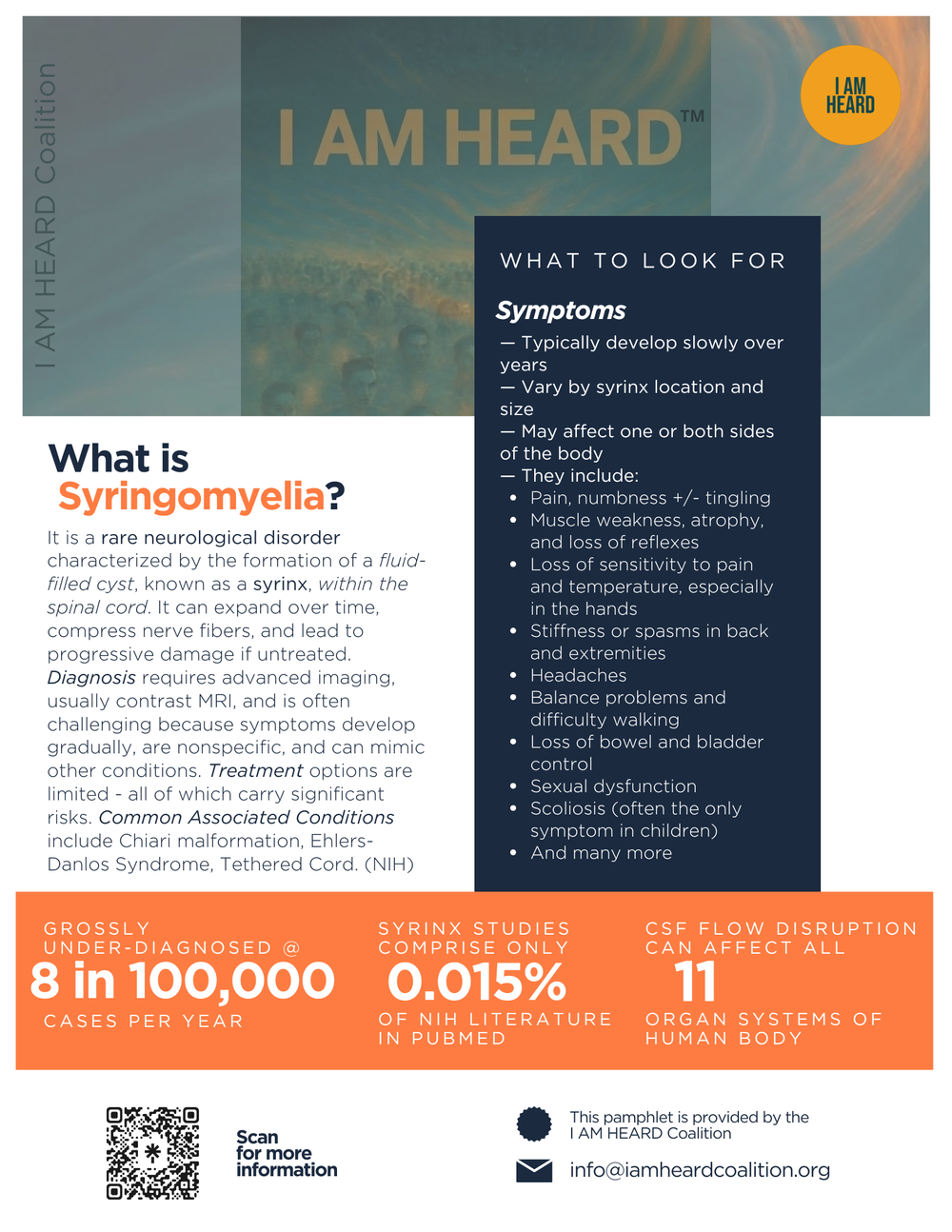
Info cards for your community
Our syringomyelia info card covers the basics on one page: what it is, what to look for, and why it’s so often missed. Hand them out at support groups, community events, and your providers’ offices.
Email info@iamheardcoalition.org for details on getting a bulk supply.
Is syringomyelia the same as Chiari malformation?
No. Chiari malformation is a structural difference at the base of the skull, where brain tissue extends into the spinal canal. Syringomyelia is a fluid-filled cavity inside the spinal cord. Chiari is the most common cause of syringomyelia, but you can have one without the other.
Is syringomyelia progressive?
It can be. The course is unpredictable, with periods of stability and periods of progression. Symptoms often develop slowly over months to years, and some people stay stable for a long time.
Can a syrinx go away on its own?
Sometimes. It’s more common in children, as the skull grows and fluid flow improves. In adults it’s less common, but it does happen.
My syrinx is small. Can it still cause symptoms?
Size is only part of the picture. Where the syrinx sits and how far it extends matter too, and symptoms don’t always line up neatly with the measurement on a scan. If you have symptoms, they deserve to be taken seriously.
Can I still exercise?
Many people stay active. The National Institute of Neurological Disorders and Stroke advises avoiding straining activities such as heavy lifting and jumping, which can trigger symptoms. Work with your care team on what’s right for you.
How do I find a provider who understands syringomyelia?
Start with our provider directory. You can also ask for a referral to a neurologist or neurosurgeon who regularly treats syringomyelia and Chiari malformation.
How can I get involved?
Join or start a chapter where you live, share your story, or see more ways to help on our Get Involved page.
You don’t have to do this alone.
Find a provider who knows this condition, connect with others through a local chapter, or help fund care packages, patient grants, and the Regenerative Therapy Access Program for people living with syringomyelia and associated conditions.
Disclaimer
The information on this page is for general education only. It is not medical advice and is not a substitute for diagnosis or treatment from a qualified, licensed healthcare professional. I AM HEARD Coalition does not diagnose conditions, recommend or endorse a particular treatment, or guarantee any medical outcome.
Every person’s situation is different. Talk with your own healthcare team before making decisions about your care. If you have sudden or rapidly worsening symptoms, such as new weakness, loss of bladder or bowel control, or trouble breathing or swallowing, seek emergency care right away.
Sources
- National Institute of Neurological Disorders and Stroke. Syringomyelia. ninds.nih.gov
- Shenoy VS, Munakomi S, Sampath R. Syringomyelia. StatPearls. Updated 2024. ncbi.nlm.nih.gov/books/NBK537110
- National Library of Medicine. PubMed record counts for “syringomyelia OR syrinx” compared with all records, November 2026. pubmed.ncbi.nlm.nih.gov
- Henderson FC Sr, et al. Neurological and spinal manifestations of the Ehlers–Danlos syndromes. Am J Med Genet C. 2017. doi.org/10.1002/ajmg.c.31549
- Severance S, et al. Hypermobile Ehlers-Danlos syndrome and spontaneous CSF leaks: the connective tissue conundrum. Front Neurol. 2024. pmc.ncbi.nlm.nih.gov/articles/PMC11289524